
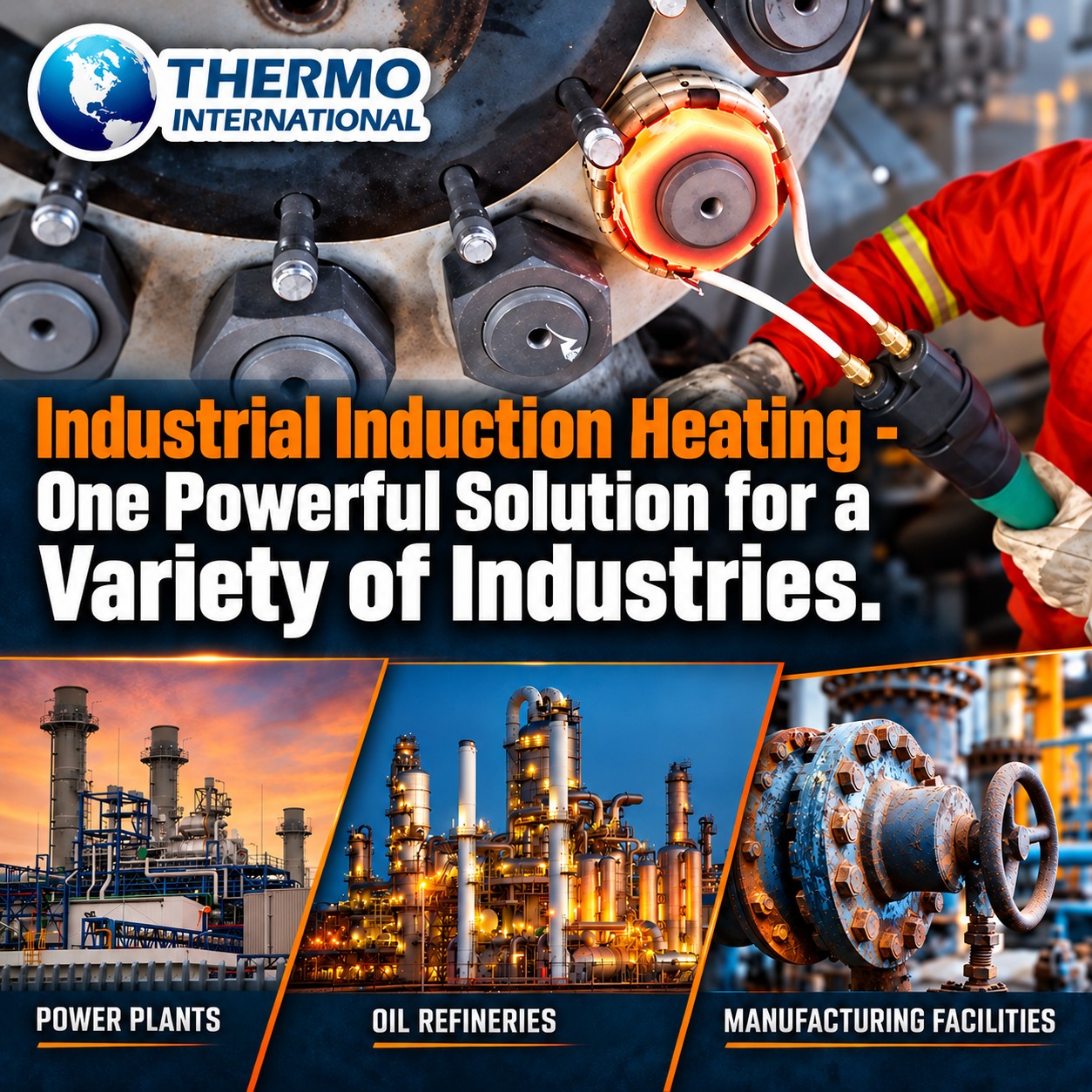
A turbine bolt that won’t loosen. A weld joint that needs consistent preheat. A coupling that must expand enough for removal without overheating nearby components.
These jobs present different challenges, but they share a common requirement: getting the right amount of heat into the right location, at the right time.
Industrial induction heating uses electromagnetic energy to generate heat directly within electrically conductive materials. For engineers and maintenance teams, it offers a practical way to control heating during equipment assembly, disassembly, welding, and heat treatment.
Thermo International designs and manufactures induction heating equipment for demanding industrial applications. With a properly matched power supply, coil, and control system, crews can deliver controlled heating to components on the plant floor or job site.
How Does Industrial Induction Heating Work?
Alternating current flows through an induction coil, creating a changing magnetic field. That field induces electrical currents within the metal workpiece. The metal’s electrical resistance converts those currents into heat.
Because the heat is generated within the metal, induction does not depend on an open flame or a resistance element transferring heat into the component.
Coil design determines where energy is applied. A small inductor can target a selected area, while a different coil arrangement can support heating around a pipe, flange or larger component.
Uniformity still requires engineering. Material, geometry, frequency, coil placement, heating time and temperature monitoring all influence the resulting temperature profile.
Where Is Industrial Induction Heating Used?
Industrial induction heating applications include:
- Bolt and nut heating.
- Welding preheat.
- Post-weld heat treatment.
- Hydrogen bake-out.
- Selected line-thawing applications.
- Coating removal.
- Welding fabrication and construction.
- Shrink fitting.
- Thermal expansion for component installation and removal.
Each application requires an equipment setup and heating procedure suited to the workpiece and the desired result.
Bolt and Nut Heating for Industrial Maintenance
Large bolts and studs can be difficult to remove after extended service in turbines, steam valves and heavy machinery.
Induction bolt heating creates controlled thermal expansion. For hollow bolts, a properly sized inductor can be positioned inside the center bore to generate heat in the surrounding bolt material.
During disassembly, expansion relative to the clamped assembly can help reduce bolt load and facilitate nut movement under the specified bolting procedure. Where appropriate, an external nut-heating coil can provide targeted nut expansion.
Induction can also support thermal tightening during reassembly. The bolt is heated, the nut is positioned according to the procedure, and cooling and contraction develop clamping load.
The objective is to achieve the specified expansion within approved temperature limits. Thread condition, joint geometry and the required mechanical operations remain important to a successful result.
Welding Preheat
For many welding applications, the heating work starts before the first weld pass.
Preheating helps manage cooling rates and reduce the risk of hydrogen-assisted cracking in susceptible materials. The required preheat depends on factors such as material grade, thickness, joint restraint and the welding procedure.
Induction heating can apply controlled heat around the weld area and help maintain the required temperature during fabrication.
Applications include pipe welding, pressure equipment repairs, structural fabrication and heavy component construction. With suitable controls and temperature measurement, crews can maintain the specified heating conditions as welding progresses.
Post-Weld Heat Treatment
Some welded assemblies require post-weld heat treatment, or PWHT, to reduce residual stresses or achieve specified material properties.
This is a controlled thermal process. It may require defined heating rates, holding temperatures, soak times and cooling rates, together with temperature records.
Induction equipment configured for PWHT can deliver heat to the required treatment zone. Coil arrangement, insulation, thermocouple placement and control capability must support the applicable procedure.
Faster heating does not justify shortening a required soak period or exceeding an approved ramp rate. The equipment must follow the treatment requirements.
Hydrogen Bake-Out
Hydrogen bake-out uses controlled heating to help diffusible hydrogen leave susceptible steel. It may be specified before repair welding on equipment exposed to hydrogen-bearing service or as part of a welding-related hydrogen control procedure.
The treatment depends on the material, service history, thickness and approved engineering requirements.
Induction heating can support the controlled temperature and holding period needed for the application. Hydrogen bake-out and stress-relief PWHT serve different purposes and should not be treated as interchangeable processes.
For refinery and process equipment, defining the treatment requirements before mobilization helps establish the correct equipment and monitoring package.
Line Thawing
Selected frozen metallic piping applications may be candidates for induction heating. The system heats the conductive pipe wall, which transfers heat toward the frozen contents.
Suitability depends on the pipe material, contents, pressure condition, accessibility and potential damage from freezing.
Before heating begins, the line needs an approved thawing plan that addresses isolation, pressure relief, temperature limits and inspection requirements. A blocked or frozen line should never be assumed safe to heat simply because induction has no open flame.
Thermo International can discuss the application details to help assess whether an induction setup is appropriate.
Coating Removal
Removing industrial coatings can be time-consuming, particularly across large metal surfaces.
Induction coating removal heats the metal beneath a suitable coating, helping weaken the bond between the coating and its substrate so the material can be lifted or scraped away.
The process may be useful for selected coating systems on piping, tanks and other steel structures. Performance depends on the coating chemistry, thickness, substrate and access.
Temperature control matters. The goal is to release the coating while limiting unnecessary heating of the base metal. Removed material and any emissions must still be managed according to the coating’s composition and site requirements.
Welding Fabrication and Construction
In fabrication shops and construction environments, heating needs often change from one assembly to the next.
A crew may need to preheat a pipe joint, maintain temperature during welding or heat a heavy component before fitting. Portable induction equipment can bring the heat source to the work and support these different tasks with compatible coils and accessories.
Depending on the system configuration, operators can use manual controls or programmable heating cycles. Temperature monitoring and recording can support repeatability and quality documentation where required.
For engineers, the practical benefit is a heating arrangement that can be planned around the work sequence, access restrictions and available utilities.
Shrink-Fit Applications
Shrink fitting uses thermal expansion to create temporary clearance between mating components.
Heating an outer component, such as a coupling or hub, increases its dimensions enough to support installation over a shaft. As it cools, the component contracts to form the intended interference fit.
Induction heating can support this process by applying controlled heat to the selected component.
The required temperature depends on the material, dimensions, interference and manufacturer’s limits. Sensitive components, seals and existing heat treatments may impose additional restrictions.
Successful shrink fitting starts with the required fit and assembly procedure—not a universal target temperature.
Thermal Expansion for Component Removal
Thermal expansion also supports disassembly.
Retaining rings, couplings, hubs and other interference-fit components may require heating to create clearance for removal. Applying heat to the intended component while controlling heat transfer into the mating part can help crews complete the operation.
The setup must account for component mass, geometry, access, lifting arrangements and the time available to perform the mechanical work.
For maintenance teams, coordinating heating and handling is just as important as selecting the power supply.
How Fast Is Industrial Induction Heating?
For suitable applications, induction can reduce the time needed to reach the required temperature compared with conventional heating methods. Some heating tasks can be completed in minutes.
However, there is no single heating time that applies to every industrial component.
Cycle time depends on:
- Material and component mass.
- Starting and target temperatures.
- Required heating depth and uniformity.
- Available power and operating frequency.
- Coil design and positioning.
- Heat losses and insulation.
- Required ramp rates and holding periods.
A heating cycle that takes minutes does not necessarily mean the entire maintenance task takes minutes. Setup, monitoring, handling, cooling and inspection also affect the schedule.
For outage planning, use application-specific estimates that distinguish heating time from total job duration.
Why Engineers Consider Induction Heating
Controlled heat delivery
An appropriately designed coil directs energy into the intended area. Temperature feedback and suitable controls help the system follow the required process.
Heating without an open flame
Induction removes the combustion flame from the heating operation and avoids using an exposed resistance element as the heat source.
The workpiece still becomes hot, and nearby components or tooling can heat through conduction and radiation. Appropriate handling and site controls remain necessary.
Reduced dependence on fuel gases
The induction heating process uses electrical power, reducing the need for fuel-gas cylinders, storage and handling for that heating task.
Operating cost depends on electricity use, cooling needs, labor, setup and cycle time.
Fewer combustion-related emissions
Induction produces no combustion exhaust at the heating point. Depending on the application, it can also reduce reliance on consumable heating arrangements that contribute debris.
Coatings, oils and contaminants may still produce fumes when heated, and some jobs still require insulation. Emissions and housekeeping requirements should be assessed for the actual application.
Flexible equipment deployment
Compatible coils and accessories allow a power supply to support different heating tasks within its operating capabilities. This can be useful when an outage includes several component types or maintenance activities.
What Information Does Thermo International Need?
The most useful starting point is a clear description of the component and the required outcome.
Share:
- The application: Loosening, tightening, preheating, heat treatment, fitting or removal.
- Material and dimensions: Grade, wall thickness, bore dimensions and component mass where available.
- Thermal requirements: Target temperature, maximum limits, heating rates and hold periods.
- Site conditions: Access, electrical supply, cooling arrangements and environmental restrictions.
- Quality requirements: Temperature measurement, data recording and acceptance criteria.
- Schedule: Number of components, work sequence and outage dates.
Drawings and photographs help identify clearance restrictions, coil access and cable-routing requirements before equipment reaches the site.
Put Controlled Induction Heat to Work
Effective industrial heating starts with understanding what the component needs and how the crew will complete the work.
Thermo International helps engineers and maintenance teams evaluate induction heating equipment for demanding assembly, disassembly, fabrication and heat-treatment applications.
Tell us what you need to heat, the result you need to achieve and when the work needs to happen. We’ll help match the power supply, coils and accessories to your application.
Call Thermo International: 973-970-9500
Visit ThermoInternational.com