
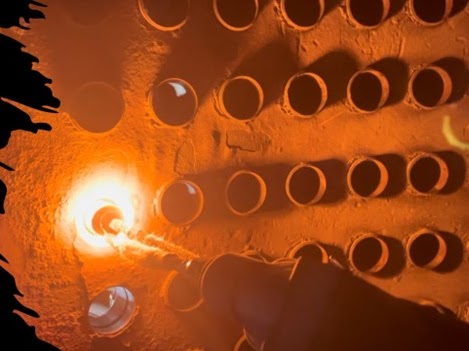
Stubborn Boiler Tubes? How Induction Heating Helps Maintenance Crews Remove Them
Removing a worn boiler tube can become one of the most difficult parts of a replacement project. Years of service, corrosion and a tightly expanded joint can leave the tube firmly attached to the tube sheet or drum.
For maintenance engineers, the objective goes beyond getting the old tube out. The surrounding bore must remain suitable for the replacement tube, and the removal process needs to fit the outage schedule.
Induction heating supports boiler tube removal by heating the tube locally at its expanded joint. Because the surrounding tube sheet restrains expansion, the heated tube can undergo permanent deformation. Depending on the approved method, crews then extract the tube while hot or allow it to cool and contract before removal.
Thermo International supplies induction heating equipment and application-specific coils to help maintenance teams address these demanding removal jobs.
Why Are Boiler Tubes Difficult to Remove?
Boiler tubes may be mechanically expanded into tube sheets, drums or headers. Depending on the design, the joint may also include grooves, a flared or belled end, or a weld.
These features help secure the tube during operation. During maintenance, they can make extraction difficult.
Corrosion, deposits, tube distortion and excessive expansion can add resistance. Thin or deteriorated tube walls may also make it harder for a pulling tool to grip effectively.
Applying more pulling force is not always the best answer. The removal method must account for the joint design, tube condition and the need to preserve the surrounding pressure-boundary component.
How Does Induction Heating Release the Tube?
An induction coil is positioned inside the tube near the section held in the tube sheet or drum.
Alternating current flowing through the coil creates a changing magnetic field. This induces electrical currents in the tube wall, generating heat directly within the metal.
The important effect occurs at the restrained joint:
- The tube attempts to expand as it heats.
- The surrounding bore restricts outward expansion.
- At the specified heating condition, the tube material can deform permanently.
- Subsequent extraction or cooling helps release the mechanical fit.
Heating does not simply make metal shrink. The process depends on thermal expansion under restraint, permanent deformation and—in a heat-and-shrink method—contraction during cooling.
That distinction matters when engineers evaluate the method and establish a removal procedure.
Heat-and-Pull and Heat-and-Shrink Methods
Two approaches are used in induction-assisted tube extraction. The appropriate choice depends on the assembly and the approved work procedure.
Heat and pull
The tube stub is heated locally, and an extraction tool applies the required mechanical force while the material is hot.
This approach can be useful for certain heavily expanded tube stubs. Successful removal depends on coordinating the heating arrangement, pulling equipment and access.
Heat and shrink
The tube stub is heated under restraint and then cooled according to the procedure. After permanent deformation during heating, cooling can reduce its grip in the bore.
The crew then removes the released stub with suitable tooling.
Neither approach is a universal solution. The joint geometry, tube material, remaining wall thickness and surrounding component limits determine what is appropriate.
Does Induction Heating Replace All Cutting and Preparation?
No. Induction heating addresses the tube’s attachment at the expanded joint; it does not automatically eliminate every preparation step.
For example, a welded tube connection may require weld removal before extraction. The work scope may also include cutting the tube to create an accessible stub, removing obstructions or preparing an extraction path.
Engineers should identify whether the connection is:
- Mechanically expanded.
- Expanded into a grooved bore.
- Belled or flared.
- Welded and expanded.
- Distorted or damaged from service.
Understanding the connection before mobilization helps prevent equipment and tooling mismatches.
How Can Induction Heating Help Protect the Tube Sheet?
Conventional removal may involve splitting, cutting or mechanically working the tube stub close to the bore surface. These operations require care to avoid damaging the tube seat.
Induction offers another way to weaken the mechanical fit by heating the tube from within.
With a suitable coil and controlled cycle, the process can reduce the amount of cutting or forceful removal needed at the joint. This may help limit scoring and other damage associated with extraction.
However, localized heating does not mean the surrounding metal stays cold. Heat still transfers into the tube sheet or drum. The procedure must control the heated zone, temperature and duration.
Bore inspection remains necessary after removal. Induction heating does not eliminate the need to verify the condition of the tube seat before installing a replacement.
How Long Does Boiler Tube Removal Take?
There is no single cycle time that applies to every boiler tube.
Heating time depends on tube diameter, wall thickness, material, joint length, coil design and available power. Removal time also depends on access, preparation and the method used to extract the tube.
For scheduling, separate the work into:
- Joint preparation and access.
- Coil and extraction-tool positioning.
- Heating.
- Cooling, if required by the method.
- Tube or stub removal.
- Bore cleaning and inspection.
A short heating cycle can be valuable, but the total time per tube is the more useful number for outage planning.
For a large replacement scope, a representative trial can help establish realistic cycle times and reveal restrictions before the full job begins.
What Equipment Does the Job Require?
A complete setup typically includes an induction power supply, a compatible internal coil, cables and connections, cooling provisions, temperature monitoring and suitable extraction equipment.
The coil must fit the available tube bore and apply energy to the intended joint section. Deposits, deformation or restricted access may affect that fit.
The extraction equipment must also suit the tube condition and available reaction surfaces. A higher-rated power supply alone will not resolve an unsuitable coil arrangement or inadequate pulling access.
Thermo International can help evaluate the heating equipment and accessories needed for the application.
What Should Maintenance Engineers Confirm Before the Outage?
Provide as much of the following information as possible:
- Tube dimensions: Outside diameter, inside diameter and remaining wall thickness.
- Materials: Tube grade and tube-sheet, drum or header material.
- Joint details: Expanded length, grooves, welds, bells or flares.
- Condition: Corrosion, deposits, distortion and known damage.
- Access: Clearance for the coil, cables, extraction tools and personnel.
- Utilities: Available electrical supply and cooling arrangements.
- Work scope: Number of tubes, replacement sequence and schedule.
- Acceptance requirements: Heating limits, inspection requirements and replacement-joint criteria.
Drawings and photographs often reveal details that dimensions alone cannot capture.
The boiler must also be isolated, depressurized, drained and prepared under the site’s approved maintenance procedures before work begins.
When Is Induction Heating Worth Evaluating?
Induction-assisted removal is worth considering when expanded tube joints are difficult to release, conventional extraction requires excessive force, or preserving the bore is a major concern.
It may also offer value when a project involves many similar tube stubs and the crew can repeat a validated setup.
It is less useful to treat induction as a blanket replacement for every tube-removal method. The strongest approach is to assess the actual joint and compare preparation, heating, extraction and inspection requirements together.
Plan Your Boiler Tube Removal with Thermo International
A successful tube-removal project starts with understanding what is holding the tube in place.
Thermo International helps maintenance engineers evaluate induction heating for challenging boiler tube and tube-stub removal applications, with equipment and coils matched to the work.
Send us your tube dimensions, material, joint drawings or photos, and outage schedule. We’ll help assess the right induction heating setup for your project.
📞 973-970-9500
🌐 ThermoInternational.com