
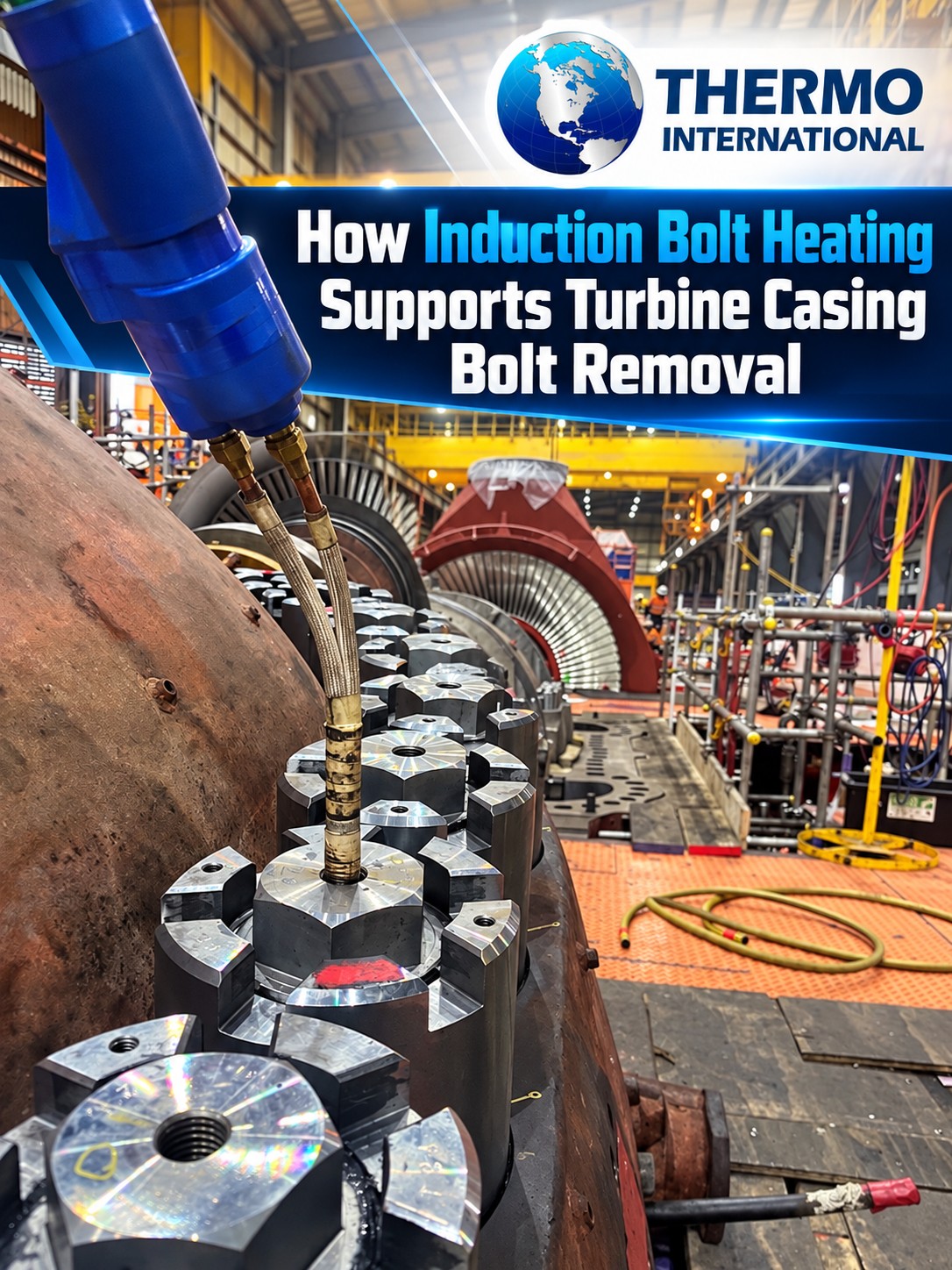
During a turbine outage, removing the casing bolts is an early step that can affect everything that follows. Inspection, repairs and component access depend on getting the turbine open.
For maintenance engineers, the challenge is to create the bolt expansion needed for loosening while controlling temperature and limiting unnecessary heat transfer into the surrounding assembly.
Induction bolt heating generates heat directly within a turbine bolt using an inductor positioned inside its center bore. Rapid, controlled heating allows the bolt to expand relative to the clamped assembly, helping crews loosen the nut under the specified bolting procedure.
Thermo International’s portable induction heating systems help maintenance teams apply this approach to large turbine casing bolts and studs.
How Does Induction Heating Work Inside a Turbine Bolt?
Many large turbine bolts have a center bore designed to accommodate conventional electric resistance heaters. A properly sized induction bolt heating wand can use that existing bore.
Alternating current flows through the inductor, creating a changing magnetic field. That field induces electrical currents within the surrounding bolt material. The metal’s electrical resistance converts those currents into heat.
With an internal inductor, heating begins in the bolt material around the bore and spreads through the metal by conduction.
The important distinction is where the heat originates: induction generates heat within the bolt, while a conventional resistance heater generates heat in its element and transfers it into the bolt.
Matching the inductor to the bore and required heating length helps establish an effective heating arrangement.
Why Heating Speed Matters During Turbine Bolt Removal
The bolt and turbine casing form a connected thermal system. As the bolt heats, some energy transfers into the nut, flange and surrounding structure.
A shorter heating cycle gives that energy less time to spread before the crew performs the loosening operation.
This supports a useful temperature difference between the bolt and the clamped assembly. As the bolt expands axially relative to that assembly, its tensile load can decrease enough to facilitate nut movement.
The objective is to achieve the required expansion within the approved temperature limits and complete the mechanical operation at the appropriate point in the cycle.
Heating longer or reaching a higher temperature does not automatically improve the result. The heating arrangement, bolt material and maintenance procedure must work together.
What Does Localized Heating Mean for the Turbine Casing?
Localized induction heating concentrates energy in the intended bolt section. It can help limit unnecessary heating of the turbine casing by reaching the required bolt condition quickly.
It does not mean that the casing remains cold or that heat transfer stops. Conduction continues wherever heated parts contact surrounding metal.
For maintenance engineers, the practical benefit is greater control over the heating location and duration. The approved procedure should establish the temperature limits, monitoring requirements and loosening sequence.
This becomes particularly important when crews work through multiple bolts on the same assembly.
Four Benefits for Turbine Maintenance Teams
1. Controlled expansion of large bolts and studs
A suitable machine and inductor combination supports the thermal expansion needed for the bolting task.
Successful removal also depends on the condition of the threads, nut and joint. Heating can relieve load, but it does not repair damaged threads or guarantee that every seized fastener will release.
2. Rapid heating where it is needed
Generating heat within the bolt can shorten the heating stage compared with a suitable conventional resistance-heating setup.
The actual improvement depends on bolt dimensions, material, available power, inductor fit and starting conditions. Application-specific results provide a better planning basis than a universal speed claim.
3. Heating without an open flame
Induction provides an electrically powered heating method without an open flame. Conventional electric resistance heaters are also flame-free, so the principal comparison between those two methods concerns heat delivery and cycle performance.
The bolt and nearby surfaces still become hot and require appropriate handling.
4. Better coordination of disassembly work
Shorter, predictable heating cycles can help crews coordinate nut removal, tool positioning and movement between fasteners.
The impact on total outage duration depends on whether bolt removal is on the critical path and how the remaining work is organized.
How Long Does It Take to Heat a Large Turbine Bolt?
There is no single heating time that applies to every turbine bolt.
The required cycle depends on:
- Bolt material and dimensions.
- Bore diameter, depth and condition.
- Length of the section being heated.
- Initial temperature and required expansion.
- Inductor design and position.
- Available machine output.
- Heat transfer into the surrounding assembly.
For scheduling, distinguish time to achieve the required bolt condition from total time to remove the fastener.
A complete work estimate includes setup, monitoring, nut movement, tool changes and repositioning. A fast heating cycle delivers the most value when the crew and equipment are ready for the next step.
What Should Engineers Confirm Before the Outage?
Preparing the application details early helps Thermo International assess the heating equipment and accessories required.
| Planning item | Information to confirm |
|---|---|
| Bolt geometry | Outside diameter, overall length, bore diameter and usable bore depth |
| Material | Bolt grade and applicable temperature restrictions |
| Bolting procedure | Required expansion or measurements, heating limits and loosening sequence |
| Access | Clearance for inductors, cables, tools and personnel |
| Utilities | Available electrical supply and cooling arrangements |
| Work scope | Number of bolts, different bolt sizes and project schedule |
| Equipment package | Machine, inductors, cables, cooling and monitoring accessories |
Photographs and drawings can reveal restrictions that a dimensional list may miss. An obstructed bore, limited overhead clearance or difficult cable route can change the recommended setup.
Match the Inductor and Power Supply to the Bolt
Thermo International offers portable induction heating systems in 60kW, 120kW and 200kW power classes.
Selecting the appropriate system requires evaluating the whole application. A higher maximum power rating alone does not establish the best heating cycle.
The inductor must fit the bore, couple energy effectively into the required section and operate with compatible cables and connections. The power supply must support that arrangement under the available site conditions.
If your outage includes several bolt sizes, provide the complete list before mobilization. That allows the required inductors and accessories to be considered together.
Thermo International also offers engineering support for heat-load requirements, thermal analysis and job-site setup recommendations.
Can Induction Heating Support Turbine Reassembly?
Induction heating can also support thermal tightening where the approved procedure calls for it.
During reassembly, the bolt is heated to achieve the specified condition, and the nut is positioned according to the procedure. Cooling and contraction then develop clamping load.
The acceptance criteria for tightening differ from the objective of loosening. Final joint condition depends on the prescribed measurements and checks—not heating time alone.
Discussing both disassembly and reassembly requirements helps establish a more complete equipment plan.
Get Ready for Your Next Turbine Outage
Effective turbine bolt heating starts with understanding the fastener, the joint and the work sequence.
Thermo International helps maintenance engineers assess induction heating equipment for large turbine bolts and studs, with application-specific inductors and accessories.
Send us your bolt dimensions, bore size, material, drawings or photos, and outage schedule. We’ll help match the machine and inductors to your job.
Call 973-970-9500
Visit ThermoInternational.com