
The Complete Engineering Guide to Turbine Bolt Heating, Turbine Maintenance, and Industrial Induction Heating Systems
Power plants operate on strict maintenance schedules. When a steam turbine outage occurs for inspection or repair, every hour of downtime directly affects electricity production and revenue. Maintenance teams must disassemble and reassemble large turbine components safely while minimizing delays.
One of the most effective technologies used during modern turbine outages is portable induction bolt heating.
Induction heating systems allow maintenance crews to apply precise, localized heat directly inside turbine bolts, studs, nuts, and shrink-fit components, enabling faster disassembly and safer reassembly of high-value rotating equipment.
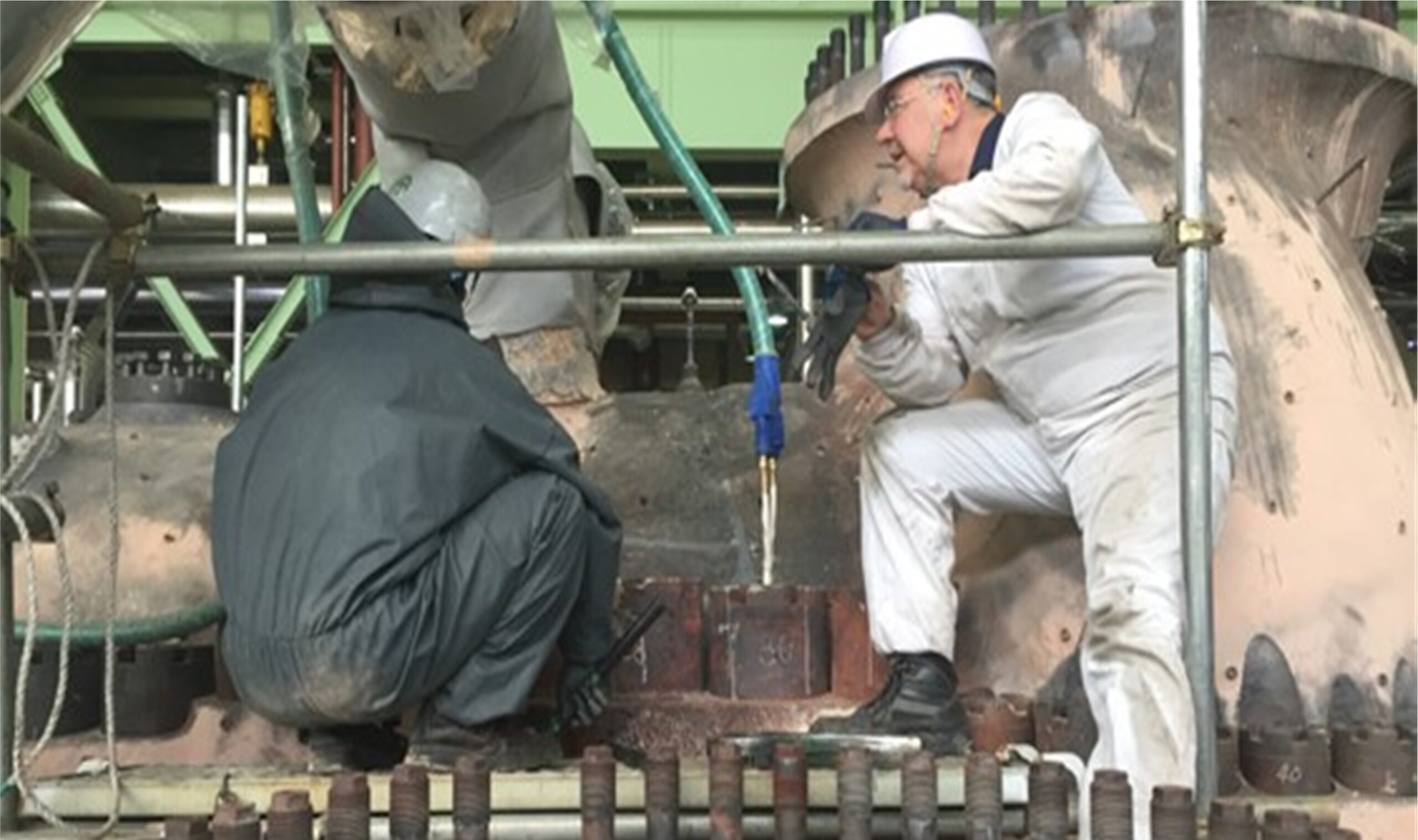
Induction bolt heating systems enable faster disassembly and safer reassembly of high-value rotating equipment.
Today, induction bolt heating is widely used across steam turbines, gas turbines, nuclear power plants, industrial turbines, and large rotating machinery.
This guide explains:
-
how induction bolt heating works
-
why power plants use it during turbine outages
-
how induction heating improves turbine maintenance efficiency
-
how engineers select the right induction heating equipment
What Is Induction Bolt Heating?
Induction bolt heating is an industrial heating method that uses an electromagnetic field to generate heat directly within a metal fastener such as a bolt, stud, or nut.
Instead of heating the outside of the bolt with an open flame or combustion heater, induction heating produces heat inside the metal itself through electrical currents.
The process causes the bolt to expand slightly through controlled thermal expansion, allowing technicians to loosen or tighten fasteners safely using standard tools.
Induction bolt heating is commonly used in:
-
steam turbine maintenance
-
generator maintenance
-
industrial flange disassembly
-
rotating equipment service
-
removal of seized or corroded bolts
Because the heat is generated internally, the process is fast, efficient, and highly controlled.
How Induction Bolt Heating Works
The simplest way to understand induction bolt heating is by comparing it to a transformer.
An induction coil is inserted into the bore of a bolt. This coil acts as the primary winding of a transformer.
When alternating current flows through the coil:
-
A magnetic field is created.
-
The magnetic field induces electrical currents inside the bolt.
-
These currents circulate through the metal.
-
Electrical resistance inside the bolt converts this energy into heat.
The bolt behaves like a short-circuited secondary winding, meaning nearly 100% of the induced electrical energy becomes heat inside the bolt.
This internal heating expands the bolt slightly, reducing clamping force and allowing safe removal or installation.
Why Power Plants Use Induction Heating During Turbine Outages
Turbine maintenance often involves extremely large fasteners that must be removed without damaging surrounding components.
Over years of operation, turbine bolts may become difficult to remove due to:
-
corrosion
-
mechanical preload
-
thermal cycling
-
high operating temperatures
Induction heating solves these problems by delivering controlled, localized heat exactly where it is needed.
Key Advantages
Faster Turbine Disassembly
Large turbine bolts can be heated in minutes rather than hours.
Precise Heat Control
Heat is generated inside the bolt instead of heating the entire surrounding structure.
Protection of Critical Components
Threads, turbine casings, and other components remain protected.
Improved Worker Safety
Induction heating eliminates open flames and reduces the need for mechanical striking.
These advantages help power plants reduce outage time and improve maintenance safety.
Induction Heating Applications in Power Generation
Induction heating is used in several critical turbine maintenance applications.
Turbine Bolt and Stud Heating
Large bolts used to secure turbine casings must often be heated to release clamping force before removal.
Induction heating provides fast, uniform bolt expansion.
Shrink-Fit Component Expansion
Many turbine components are installed using shrink-fit techniques.
Common shrink-fit components include:
-
couplings
-
hubs
-
generator retaining rings
-
industrial bearings
Induction heating expands these parts evenly for safe installation and removal.
Generator Retaining Ring Heating
Retaining rings hold generator rotor windings in place under high mechanical tension.
Induction heating allows technicians to expand retaining rings safely before removal.
Localized Preheat for Industrial Maintenance
Induction systems can also be used for controlled preheating in heavy industrial maintenance.
Induction Heating vs Torch Heating
Before induction heating became widely available, technicians often used torches or combustion heaters to heat bolts.
While these methods generate heat, they have several drawbacks.
Problems With Torch Heating
-
uneven heat distribution
-
risk of overheating surrounding equipment
-
open flame safety hazards
-
potential damage to threads and components
Advantages of Induction Heating
Induction heating offers several engineering advantages:
-
localized heating
-
precise temperature control
-
faster heating cycles
-
improved safety conditions
Because of these benefits, induction heating has become the preferred bolt heating method for many power plants.
Selecting the Correct Induction Heating Power Level
Machine power plays an important role in bolt heating performance.
In the power generation industry, 50 kW is generally considered the minimum practical power level for induction bolt heating systems.
Typical turbine bolts range from:
-
2 inches to 5 inches in diameter
Lower power machines may require longer heating cycles, reducing the time advantage of induction heating.
Large turbines often require more powerful systems.
Examples include:
Gas Turbines
Some gas turbine bolts can reach 60 inches in length and are often made from Inconel alloys.
Nuclear Turbines
Bolts in nuclear turbines may exceed 8 inches in diameter.
In these applications, machines approaching 120 kW are often recommended.
Higher power levels significantly reduce heating time and improve maintenance efficiency.
Why Induction Frequency Matters
Induction heating performance is influenced by the operating frequency of the system.
Higher frequencies can heat metal faster but reduce the effective range of the magnetic field.
Magnetic field strength decreases rapidly as the distance between the induction coil and the bolt increases.
Through extensive field experience, many engineers have found that operating frequencies between 8 kHz and 12 kHz provide the best balance between heating efficiency and operational flexibility.
This frequency range allows:
-
efficient coupling between coil and bolt
-
tolerance for variations in bore size
-
flexibility for different bolt lengths
Inductor Design and Bolt Length Considerations
Ideally, heating would occur only in the section of the bolt located between the clamping surfaces.
For turbine bolts, this means heating only the portion between the two nuts.
However, maintaining separate inductors for every bolt length is not practical in real-world maintenance environments.
Frequent inductor changes can take more time than the small heating efficiency differences caused by minor size variations.
Lower frequency systems allow operators to use fewer inductors while maintaining effective heating performance.
Typical Turbine Bolt Heating Patterns
When loosening bolts on turbine casings, technicians typically follow a specific pattern.
Most turbine maintenance procedures begin heating near the center of the turbine casing and move outward toward each end.
This sequence helps distribute mechanical stresses evenly during casing disassembly.
Some turbine manufacturers specify alternative bolt removal patterns depending on equipment design.
Safety and Metallurgical Considerations
Some engineers initially expressed concerns that induction heating might damage bolt metallurgy.
In practice, these concerns are unfounded.
Many turbine bolts operate for years in environments reaching 600°F to 800°F, which are typical tempering temperatures for many alloy steels.
The short heating cycles used during induction bolt heating are well within acceptable metallurgical limits.
When applied properly, induction heating:
-
does not damage bolt threads
-
does not weaken fasteners
-
does not create harmful radiation
Thermo International Induction Heating Systems
Thermo International designs and manufactures portable induction heating systems used by power plants worldwide.
These systems are engineered specifically for:
-
turbine bolt heating
-
generator maintenance
-
industrial bolt removal
-
shrink-fit component expansion
Thermo International equipment combines:
-
optimized power levels
-
adaptable inductor designs
-
advanced control systems
-
wide tuning ranges
This approach provides maintenance teams with flexible heating solutions for a wide range of turbine applications.
Conclusion
Induction bolt heating has become an essential technology in modern power plant maintenance.
By generating heat directly inside turbine bolts, induction heating systems allow technicians to loosen and tighten fasteners safely while minimizing downtime and protecting valuable equipment.
For power plants seeking to improve outage efficiency and maintenance safety, induction heating offers a proven solution used across the global power generation industry.
📞 973-970-9500
🌐 ThermoInternational.com